Vitamin B12 occurs naturally almost only in foods of animal origin. If you eat meat, fish, eggs or dairy, you are probably getting enough. The people who mainly need a supplement are vegans, and often vegetarians, older adults and people taking metformin or stomach-acid medicines long term. If you suspect you are low, the right route is a blood test through your doctor, before you start a supplement.
How much B12 do I need?
Very little, measured in micrograms (µg). EFSA has set an adequate intake of 4 µg a day for adults. The reference value on EU labels (the %NRV) is 2.5 µg.
No upper intake level has been set for B12, because no adverse effects from high intakes have been identified. The NHS notes that up to 2 mg (2000 µg) a day from supplements is unlikely to cause any harm.
Where is B12 found in food?
- Meat and fish.
- Milk and cheese.
- Eggs.
- Fortified foods, such as some breakfast cereals and nutritional yeast. Check the label, because not all of them are fortified.
Fruit, vegetables, pulses and grains do not naturally contain B12.
Who is most at risk of running low?
Vegans and vegetarians. According to the NHS, people on a vegan diet who do not take a supplement or eat fortified foods are at risk of deficiency. Vegetarians who eat few eggs and little dairy are at risk too.
Older adults. B12 in food is bound to protein, and stomach acid is needed to release it. With age this process often works less well, and absorption of B12 from food drops. The B12 in supplements and fortified foods is already "free" and does not need that step.
People taking certain medicines. The NHS lists proton pump inhibitors (PPIs, such as omeprazole), metformin for diabetes, and nitrous oxide. A 2018 review (Miller) concludes that PPIs, H2-receptor antagonists and metformin lower B12 levels in the blood, and that it is reasonable for people taking them to have their B12 checked periodically by their doctor.
People with stomach or gut conditions. For example after a gastrectomy, with Crohn's disease, or with pernicious anaemia, an autoimmune condition in which the body cannot absorb B12 normally. These need a doctor, not self-treatment.
One thing that delays diagnosis: the body's B12 stores last around 2 to 5 years, so a deficiency can appear long after a change in diet.
Why do supplements contain 1000 µg when I need 4?
Because B12 absorption has a ceiling. The main route, through a stomach protein called intrinsic factor, quickly reaches its limit. Beyond that, a small fraction, roughly 1%, passes through passively, even without intrinsic factor.
According to figures summarised by Ralph Carmel in the journal Blood (2008), in a person with normal absorption:
- from a 1 µg dose, about 0.56 µg is absorbed (56%)
- from a 1000 µg dose, about 13 µg is absorbed (1.3%)
That is why a 1000 µg tablet makes sense: it provides enough B12 even when normal absorption is not working well. It also explains the "40000% NRV" you see on labels: the percentage refers to what is in the tablet, not to what you end up absorbing.
Cyanocobalamin or methylcobalamin?
Both work. According to the NIH, methylcobalamin is one of the two active forms in the body, while cyanocobalamin becomes active once it has been converted into them. Cyanocobalamin is stable, cheap and the most common form in supplements.
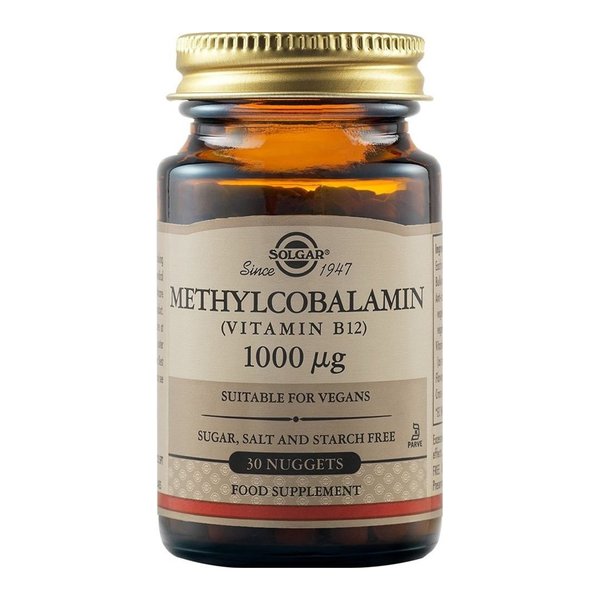
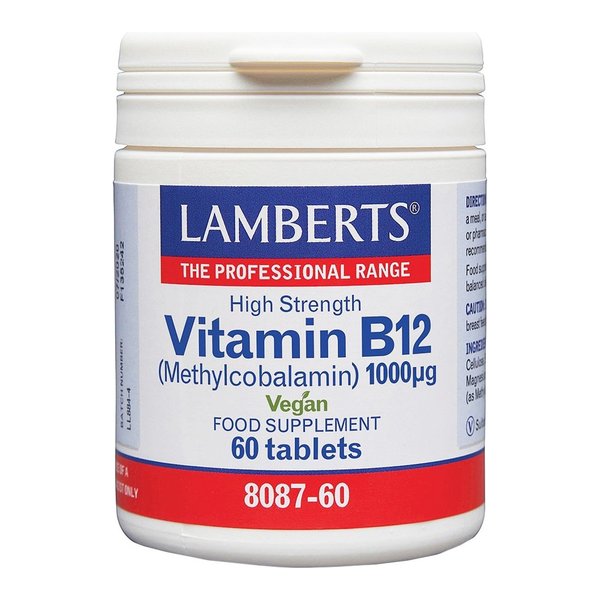
You will often read that methylcobalamin is "more natural" or "better absorbed". We did not find good comparative studies showing this in healthy people. Choose based on dose, price and whether you prefer a tablet or a chewable. The two products we suggest here are both 1000 µg methylcobalamin: Lamberts as tablets, Solgar as cherry-flavoured chewable nuggets.
How do I know if I am low?
Only with a blood test. Symptoms such as tiredness, pins and needles or anaemia have many possible causes and often take years to appear. Your doctor can order a blood B12 test and, if needed, additional markers such as methylmalonic acid.
One practical point: have the test before you start a supplement. Blood B12 rises as soon as you start taking it, which makes it hard to tell afterwards whether you were deficient and why. If the cause is an absorption problem, your doctor will decide on the right treatment.
What does B12 actually do?
The EU has authorised several health claims for vitamin B12. Some of them, as worded in the official register:
- Vitamin B12 contributes to normal functioning of the nervous system.
- Vitamin B12 contributes to normal red blood cell formation.
- Vitamin B12 contributes to the reduction of tiredness and fatigue.
- Vitamin B12 contributes to the normal function of the immune system.
- Vitamin B12 contributes to normal psychological function.
Claims such as "gives you energy" for people who are not deficient, or "prevents dementia", are not allowed. Supplements do not replace a varied diet.
Quick check
- Vegan? You need a supplement or fortified foods every day. This is not optional.
- Vegetarian who eats few eggs and little dairy? You probably need one too.
- On metformin or a PPI for years? Ask your doctor to check your B12.
- Older? Ask your doctor whether you need a test.
- Eat a variety of animal foods and feel well? You most likely do not need anything.
When to talk to a doctor or pharmacist
If you have symptoms such as marked tiredness, pins and needles or numbness in your hands or feet, or unsteadiness when walking, see a doctor and do not start a supplement on your own before the test. Also ask before you start if you are pregnant or breastfeeding, take any medication or have a health condition.
FAQ
Is it dangerous to take 1000 µg every day?
No upper limit has been set for B12, because no adverse effects have been identified. The NHS considers up to 2000 µg a day from supplements unlikely to cause harm. If you have no reason to take it, though, there is no benefit.
Can vegans get B12 from plant foods?
According to the NIH, B12 is not naturally present in plant foods. The reliable route for vegans is a supplement or foods fortified with B12, as the NHS also points out.
Are chewable or sublingual forms absorbed better?
There is no good evidence that they are. Carmel notes that the sublingual route has not been studied adequately. Choose the form you find easiest to take consistently.
Sources: EFSA, Scientific Opinion on Dietary Reference Values for cobalamin (vitamin B12) (EFSA Journal 2015, 13(7):4150), as summarised in EFSA, Dietary Reference Values for nutrients: Summary report (2017), EFSA, Overview on Tolerable Upper Intake Levels (version 11, August 2025: vitamin B12, SCF 2000), EU Regulation 1169/2011 (Annex XIII), EU Regulation 432/2012 (list of authorised health claims), Carmel R, How I treat cobalamin (vitamin B12) deficiency, Blood 2008, 112(6):2214–2221, Allen LH, Bioavailability of vitamin B12, International Journal for Vitamin and Nutrition Research 2010, 80(4–5):330–335, Miller JW, Proton pump inhibitors, H2-receptor antagonists, metformin, and vitamin B-12 deficiency: clinical implications, Advances in Nutrition 2018, 9(4):511S–518S, NIH Office of Dietary Supplements, Vitamin B12 Fact Sheet for Health Professionals, NHS, Vitamin B12 or folate deficiency anaemia: Causes, NHS, Vitamins and minerals: B vitamins and folic acid.